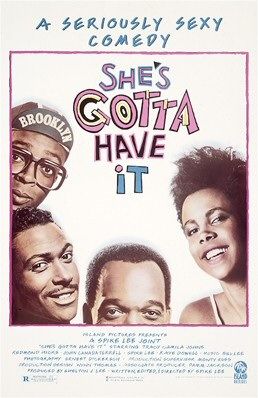
If I made a list of the top 25 films about black sexuality (sarcasm), She’s Gotta Have It would be at or near the top. The story, which today still feels a little ahead of its time, focuses on a young sister named Nola Darling who has three lovers: the pretty boy Greer Childs, the hip hop head Mars Blackmon, and the buppie Jamie Overstreet. Spike Lee says he can’t even watch his debut feature film (more on that later), but it’s an important piece of black cinema for a variety of reasons.
On to the tale of the tape…
Relevance: Regardless of whether or not the film itself is enduring, Spike set up his trademark from the first film: a story undeniably black as told by a black director (and as was often the case, involving New Yorkers). It still stands out now because of its subject matter; it’s hard to describe now how borderline revolutionary it felt to the 80s/90s generation of black America to see themselves on film, in a story that played close to their real experiences.
Legacy: Spike Lee’s first feature film. Um, isn’t that enough?
Craft: Shot for under $200,000, there was a lot of ‘one take’ scenes to make up this film. Black and white is an interesting visual choice, but any filmmaker or cinematographer will tell you that it’s also much cheaper than color. If the name Ernest Dickerson doesn’t mean anything to you, I would say use this film as a prime example of how much it helps to have a great cinematographer to tell your story.
Crossover: The film? It did okay I think. The character Mars Blackmon? Please baby please baby please baby please! He hooked up with some NBA player who was looking to take his marketability to the next level. Not sure how that turned out, I’ll have to get back to you…
Apollo: The reason Spike says he has trouble watching this film is not because of his own acting, but because of the ‘rape’ scene near the end of the film. That scene itself is hard to watch; not because it’s graphic in any way, but because it seems false to the character that does it, as does the resolution between Nola and this character. When Spike would get criticized for having no ear for writing female characters, you could trace it ALL back to this scene. It was an unfair criticism in my opinion (at least he was genuinely trying to portray black women), but it’s hard to argue against it. I think most would agree he’s gotten better with this in time.
Next up on the countdown is a film that is an adaptation of another popular piece of black work. The only hint I’ll give for now…
 malikaziz.com